Most people focus on internet speed...
But your provider only delivers bandwidth to the modem. Your router decides how that bandwidth is shared, how stable it feels, and how secure it is.
That’s why two networks with the same connection can perform very differently.
What a Router Actually Does
A router doesn’t just connect you to the internet, it manages how your network behaves.
Modern networks need to handle:
- Multiple devices at once
- Cloud apps and video calls
- Remote access
- Guest and internal traffic
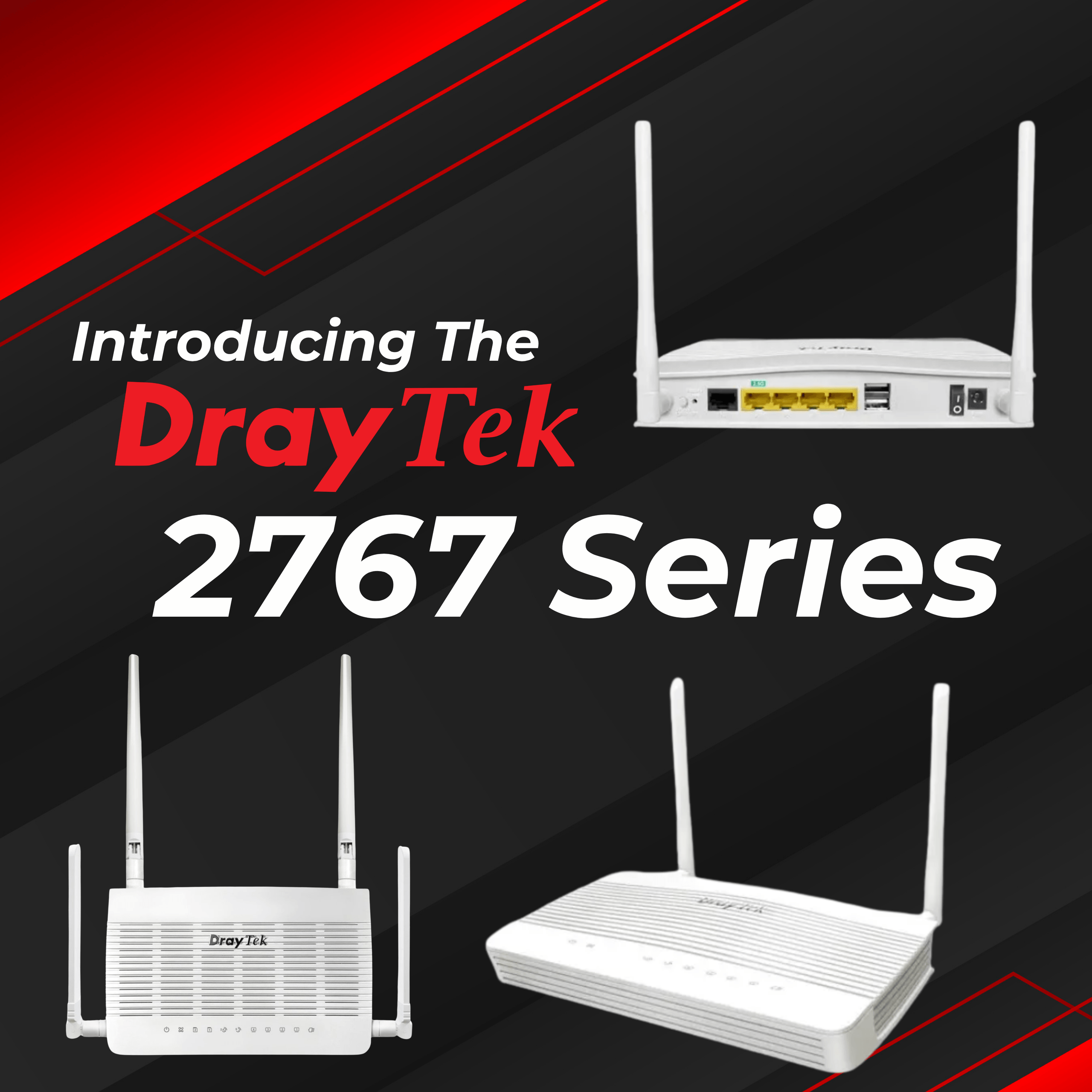
The DrayTek Vigor 2767 Series is built for this, giving you control over performance, security and access.
Across the range, you get:
- 2.5GbE connectivity (unlocks full fibre speeds without bottlenecks) With many UK providers now offering speeds over 1Gbps, standard Gigabit ports can become a bottleneck. A 2.5GbE port ensures you can actually use the full speed you’re paying for
- Support for VDSL2 and full fibre (works with both traditional broadband and fibre)
- Up to 16 VPN tunnels (secure remote access without exposing your network)
Create encrypted connections for staff to securely access office systems from anywhere, without opening your network to the internet
Why Networks Slow Down (Even with Fast Internet)
Speed issues are often caused by how traffic is handled, not the connection itself.
QoS (Quality of Service) allows the router to prioritise important traffic. For example, a video call can take priority over a file download, keeping it smooth.
Traffic shaping controls how bandwidth is used, preventing one device or task from overwhelming the network.
Performance issues are often the result of inefficient traffic handling rather than limited bandwidth.
QoS enables traffic prioritisation, while traffic shaping regulates bandwidth allocation across devices.
Combined with integrated congestion management, the Vigor series maintains stable throughput under load.
Together, these features make performance feel consistent, not just fast.
Keeping Traffic Separate and Secure
Not all devices should share the same network.
VLANs (Virtual LANs) split one physical network into separate segments. This means guest devices can be isolated from internal systems.
VPN (Virtual Private Network) allows users to securely connect from outside the network, as if they were on-site.
Built-in firewall and filtering features also help block unwanted traffic before it reaches your devices.
Comparing the Models
| Feature | Vigor 2767 | Vigor 2767ax | Vigor 2767ax-4G |
| Type | Wired-only router | Router with WiFi 6 | Router with WiFi 6 + Integrated LTE/4G (sim slot) |
| WiFi 6 | ❌ None | ✅ WiFi 6 (more efficient wireless) | ✅ WiFi 6 |
| 4G Backup | ❌ | ❌ | ✅ Automatic mobile failover |
| Best Fit | Structured networks (separate access points) | All-in-one setups | Networks needing uptime |
Choosing the Right Model
Each model suits a different setup.
The 2767 (wired router) is best for structured networks where wireless is handled by separate access points, giving better coverage and scalability.
The 2767ax (WiFi 6 router) is designed for simplicity, combining routing and WiFi 6 in a single device, ideal for smaller offices or home setups.
The 2767ax-4G adds resilience as a router with 4G failover, automatically switching to a mobile connection to keep your network online if your main line fails.
All three share the same core performance and features, the difference is how they fit into your environment.
Key Takeaways
A fast internet connection doesn’t automatically mean a good network. Performance depends on how traffic is managed, prioritised and secured, which is the router’s role.
The DrayTek Vigor 2767 Series gives you that control, whether you’re building a structured network, keeping things simple with an all-in-one setup, or adding resilience with 4G backup.
The key is choosing the model that fits how your network is used, not just the one with the most features.